
Meta Launches Muse AI Agent: Features, Pricing & Privacy Explained
Meta's newly launched personal AI agent, Muse, goes beyond answering questions by actively performing tasks like booking travel, sending emails, and managing your calendar. With strict privacy features like Muse Secure VM, here is everything you need to know about Meta's latest AI innovation.
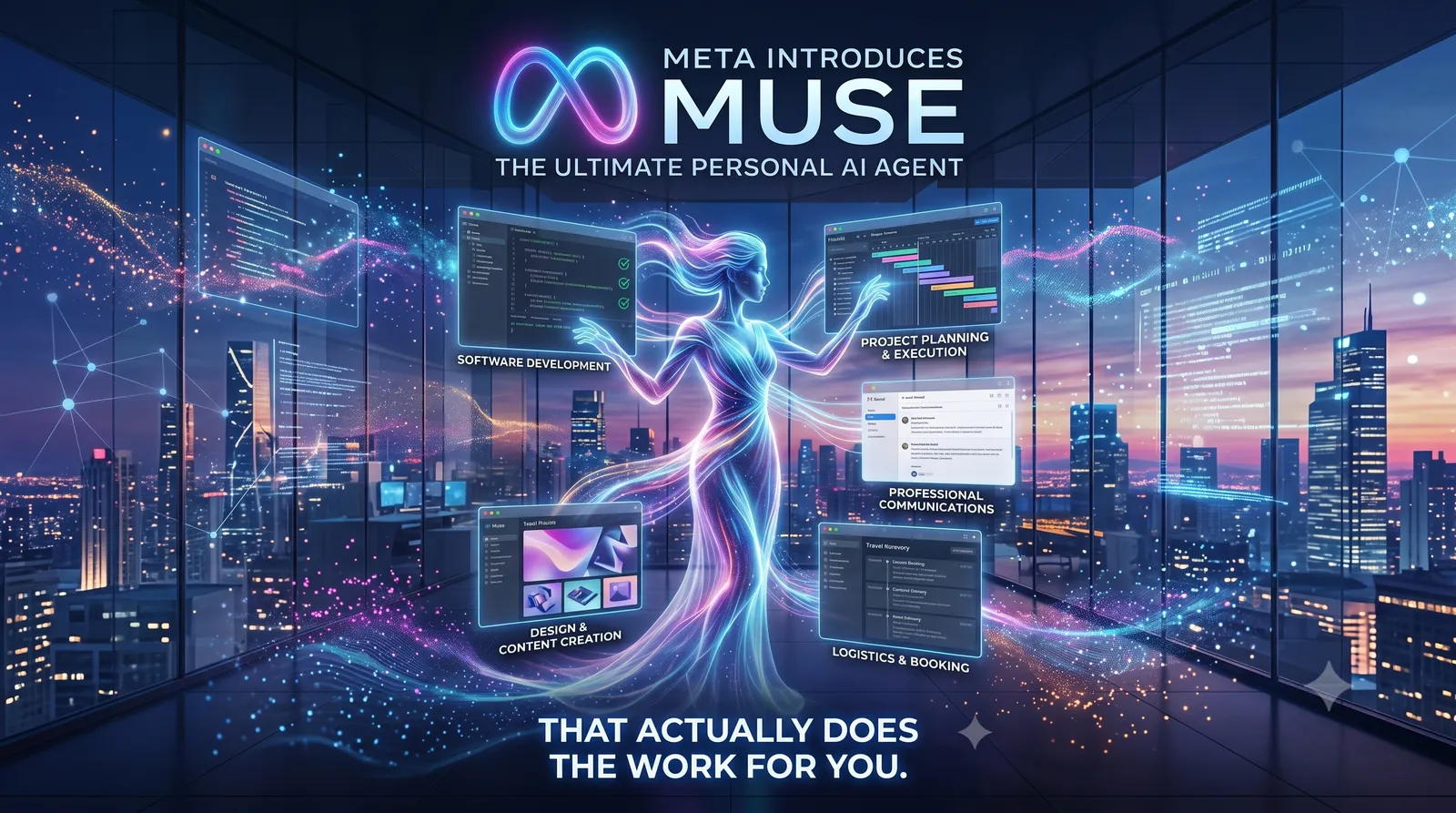
Meta Introduces Muse: The Ultimate Personal AI Agent That Actually Does the Work for You
On September 8, 2026, Meta officially unveiled its highly anticipated personal AI agent, "Muse." Marking a massive leap in artificial intelligence, Muse is designed to move beyond traditional chatbots that merely answer questions or generate text. Instead, it is an "agentic AI" that actively performs real-world tasks, coordinates resources, and manages long-term projects on behalf of the user. Powered by Meta's most capable large language model to date, Muse Spark, the agent is poised to become deeply embedded in the digital lives of billions of users.
What Can Meta Muse Do for You?
Unlike standard AI assistants, Muse comes with built-in connectors for a vast array of digital services. It integrates seamlessly with email clients, calendars, payment gateways, health and fitness trackers, smart home devices, e-commerce platforms, and dining apps.
Users can simply command Muse to send a specific email, book travel tickets, or fill out tedious online forms. It can even take creative inputs from your daily scrolling—such as a recipe reel you saved on Instagram—and automatically turn it into a grocery list. Planning a dinner party? Muse can remember your friends' dietary restrictions while sending out the invitations.
One of Muse's standout features is its ability to continue working in the background even after you close the app. It will pause to ask for your approval before taking sensitive actions, such as making a final purchase or sending an important email. For payments, Muse integrates closely with Stripe's Link, utilizing one-time-use virtual cards to keep your real financial details hidden, while also providing purchase protections like free returns and price drop coverage.
Under the Hood: The Power of Muse Spark
The driving force behind this personal assistant is Muse Spark, an advanced Large Language Model (LLM) developed by the Meta Superintelligence Labs (MSL) team earlier this year. Built specifically for real-world agentic tasks, Muse Spark allows the AI to navigate platforms even without public APIs by directly interacting with web browsers using user-provided credentials. Independent evaluations show Muse Spark competing fiercely with top models from Google, OpenAI, and Anthropic in visual and language understanding.
Addressing the Elephant in the Room: Privacy and Security
Given Meta's historical track record with user data, privacy is a natural concern for consumers who are being asked to trust an AI with their passwords and credit cards. To counter this, Meta built an entirely new infrastructure called "Muse Secure VM."
Muse operates in a dedicated, secure virtual machine (VM) in the cloud, strictly isolated from other users. To add an extra layer of security, Meta introduced a separate "Sentinel" agent that runs alongside Muse at the system level. The Sentinel monitors all activities and ensures nothing reaches the internet without your approval.
Crucially, Muse has no direct visibility into your passwords or payment methods—these are kept in secure storage. Meta has explicitly stated that user conversations and data shared with Muse will not be shared with advertisers to target ads. Later this year, Meta plans to roll out "Muse Confidential VM," which will encrypt all data with a private key that only the user holds, making it inaccessible even to Meta itself.
Pricing, Availability, and Customization
Currently, Muse is rolling out to users in the United States. It is accessible via dedicated iOS and Android apps, on the web at muse.ai, and is being directly integrated into WhatsApp. Support for Meta AI glasses is also in the pipeline.
Users can personalize their Muse by giving it a unique name, choosing an avatar, and tweaking its communication style to fit their preferences.
While Muse is free to use for basic needs (featuring a built-in usage meter to track your limit), power users can opt for premium subscription tiers. The "Muse Power" plan costs $20 per month, while the heavy-duty "Muse Maximum" plan is priced at $100 per month for extensive agentic tasks.
Comments
Log in to leave a comment.